
Link to original post here.
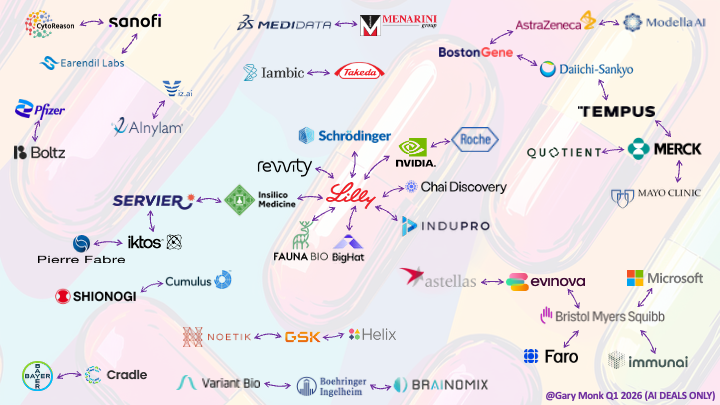
Q1 of this year was a turning point for artificial intelligence in pharma. But it was not about the number of deals, although that number was significant. Doubling to thirty-six major AI partnerships in Q1 2026 versus eighteen in Q1 2025.
It is what sits behind those deals that really matters.
We are seeing AI activity that spans multiple pharma domains simultaneously: drug discovery, diagnostics, clinical development, and now embedding itself into the deeper plumbing of manufacturing and commercial functions. As well as breadth, we are seeing depth. AI integrating itself profoundly into the pharma operating model rather than sitting alongside it as an innovation experiment.
The deals announced between January and March were not pilots. They were architectural decisions. Multi-year terms. Billion-dollar values. Third and fourth extensions on relationships that were already mature. And in at least one case, an acquisition to a recent partnership. Taken together they tell a story about an industry that has stopped asking whether AI works and started asking how to build around it permanently.
The Lilly Blueprint
In Q1 no company was a better exemplar than Eli Lilly. Eight significant AI partnerships in a single quarter is extraordinary by any measure, but the structure of those deals is more revealing than the volume.
Lilly literally bet all its chips on AI-enabled drug discovery in this quarter. The first company to deploy NVIDIA's DGX B300 AI supercomputer, co-investing over $1 billion in a co-innovation lab alongside it. Capital expenditure at this scale does not get unwound at the next budget review.
The Insilico Medicine collaboration, worth up to $2.75 billion, is not a discovery bet on a single programme. It is a platform commitment across multiple targets and therapeutic areas with milestone-driven payments tied to pipeline progress.
Then there is TuneLab. Lilly's federated AI model network, trained on over a billion dollars of proprietary data, expanded across Schrödinger, Revvity and BigHat in Q1. The logic is self-reinforcing: more partners generate more diverse training data, which improves the models, which attract more partners. Lilly is not just building internal capability. It is positioning itself as the connective tissue of an industry-wide AI discovery ecosystem, opening the doors to collaborators who can access Lilly data across a federated interface.
Alongside this, partnerships with Chai Discovery for biologics, InduPro for oncology membrane interactomics, and Fauna Bio for obesity target discovery, inspired by how hibernating animals regulate weight and metabolism, round out a portfolio that jointly spans biology, chemistry, compute and platform infrastructure.
Bristol Myers Squibb: Four Deals, Three Domains, One Quarter
Where Lilly went deep on discovery infrastructure, BMS went broad. Four distinct AI partnerships spanning drug discovery, diagnostics and clinical development in a single quarter is a portfolio strategy, not a series of one-off decisions.
Immunai brought AI-driven immune analysis into BMS clinical programmes, generating insights that inform patient stratification and feed back into discovery decisions. Microsoft brought AI radiology into lung cancer detection, embedding FDA-cleared algorithms into clinical workflows already operating across most US hospitals. Evinova brought agentic AI into trial design, enabling BMS to scenario-plan and optimise protocols before studies begin, shifting from running more trials to running better ones. And Faro brought AI upstream into protocol drafting and benchmarking, turning trial design into structured, optimisable infrastructure rather than a manual drafting exercise.
Each deal targets a different bottleneck. Together they suggest a deliberate attempt to embed AI across the entire development cycle rather than concentrate it in one area.
The Larger Pattern
The rest of the map tells the same story from different angles.
Daiichi Sankyo ran two AI deals with a specific strategic logic: as antibody-drug conjugates become more competitive, patient selection becomes the differentiator. BostonGene applied AI-powered digital twin models to refine which patients are most likely to respond to Daiichi's ADCs. Tempus brought in its PRISM2 foundation model to strengthen biomarker discovery and stratification across the same pipeline. Two deals, two tools, one objective: getting the right patients into the right trials.
Merck ran three deals: a genomics platform with Quotient Therapeutics for IBD target identification, a virtual cell collaboration with Mayo Clinic running AI models inside Mayo's secure environment on multimodal clinical data, and a Tempus partnership for precision oncology. GSK partnered with Noetik on virtual cell modelling for tumour biology and with Helix for population-scale genomics. Servier signed two major generative AI deals in a single week, Insilico and Iktos, with Pierre Fabre following Iktos into a separate collaboration shortly after.
Bayer and Cradle committed to a three-year protein engineering collaboration. Boehringer Ingelheim partnered with Variant Bio on kidney disease target discovery and with Brainomix on AI imaging as a co-primary endpoint in a Phase III pulmonary fibrosis trial. Using AI output as regulatory evidence is a significant escalation from using AI as an internal decision support tool, and a signal of how far that particular partnership has matured. Sanofi extended its CytoReason relationship for the third time and partnered with Earendil Labs on an autoimmune bispecific programme in a deal that could reach $2.5 billion.
And then there is AstraZeneca and Modella AI. AZ's shotgun wedding with its medical AI imaging partner, acquired outright just months after initiating the partnership, is perhaps the best poster child of an industry that wants to build AI capabilities into its operating system rather than access them at arm's length. Partnership was no longer enough.
What This Quarter Actually Means
The pilot phase of pharma AI had a recognisable signature: short engagements, narrow scope, single programmes, cautious language around proof of concept. Q1 2026 had almost none of that signature.
What it had instead was duration, scale, specificity and repetition. Companies returning to partners they already trusted and committing more. Companies building compute infrastructure they will depreciate over years. Companies embedding AI into clinical workflows as standard operating procedure. Companies acquiring rather than partnering when the strategic fit was clear enough.
The industry did not suddenly discover that AI works in Q1 2026. What happened is that enough internal evidence accumulated, across enough programmes, enough organisations, enough functions, that the case for permanent infrastructure finally outweighed the case for continued experimentation.
Pharma may have crossed the threshold from experimentation to commitment. That does not mean the hard questions have disappeared. If anything, they have become more important. Where should companies place their biggest bets? Which capabilities belong in-house and which should be outsourced? And how do organisations ensure that billions of dollars of AI investment ultimately deliver value rather than simply creating more complexity?
Thirty-six deals. Double the prior year. But that number is still the least interesting thing about this quarter.